
Rector
Rector rewrites PHP code by walking the AST and applying rules. The testo/bridge-rector package brings two things to Testo: a set of ready-made rules that convert test suites between Pest, PHPUnit and Testo, and a toolkit that lets you test your own Rector rules with Testo itself — no PHPUnit required.
Plugin class: RectorTestingPlugin\Testo\Bridge\Rector\Testing\RectorTestingPlugin. Not included in default plugins.
Installation
composer require --dev testo/bridge-rector rector/rectorConversion rules
The rules exist to move an existing test suite from one framework to another without rewriting it by hand — for example, to migrate a project from PHPUnit or Pest to Testo, to go back to PHPUnit, or to produce a mirror PHPUnit copy of the suite for a different runner.
Conversion works in three directions, and each one comes as a ready-made Rector set. The convenient way to reference a set is through a TestoRectorSetList\Testo\Bridge\Rector\Set\TestoRectorSetList constant — no path to remember and no need to assemble a list of individual rules by hand.
| Direction | Set constant |
|---|---|
| Testo → PHPUnit | TestoRectorSetList::TESTO_TO_PHPUNIT |
| PHPUnit → Testo | TestoRectorSetList::PHPUNIT_TO_TESTO |
| Pest → Testo | TestoRectorSetList::PEST_TO_TESTO |
Each set converts the constructs that have a faithful counterpart in the target framework. Anything else is left untouched rather than dropped silently — more on that just below.
Mock sets
Testo core has no mocking of its own, so the framework sets leave test doubles alone: which library the mocks move to is up to you. That choice is made by adding a separate mock set — next to PHPUNIT_TO_TESTO, or on its own:
TestoRectorSetList::PHPUNIT_TO_DOUBLEmovescreateMock()/createStub()and theirexpects()/method()/will*()/with()chains onto Double (testo/bridge-double, PHP 8.3+). Configured and partial mocks andwillReturnMap()convert too, and a PHPUnit constraint without a dedicated matcher becomes anArgument::satisfies()predicate that gives the same verdict.TestoRectorSetList::PHPUNIT_TO_MOCKERYconverts the same chains ontoMockery::mock()andshouldReceive(). Pick it when the project already uses Mockery or has to stay on PHP 8.2; expectations are then verified after each test by the Mockery adapter.TestoRectorSetList::MOCKERY_TO_DOUBLEmoves a suite that already uses Mockery onto Double:mock()/spy(),shouldReceive()/allows()/expects(),shouldHaveReceived()andMockery::close(). It doesn't care about the test framework, so it works on PHPUnit and Testo suites alike.
A mock rule rewrites a configuration statement as a whole or leaves it untouched. Forms with no faithful counterpart — prophesize(), getMockForAbstractClass(), addMethods(), withConsecutive() — stay in the code for you to port by hand.
Running a conversion
The adapter adds no CLI command of its own — conversion runs through Rector as usual. Reference the set you need from your rector.php, point it at your tests, and run the process:
// rector.php
use Rector\Config\RectorConfig;
use Testo\Bridge\Rector\Set\TestoRectorSetList;

return RectorConfig::configure()
    ->withPaths([__DIR__ . '/tests'])
    ->withSets([
        TestoRectorSetList::PHPUNIT_TO_TESTO,
        TestoRectorSetList::PHPUNIT_TO_DOUBLE, // or PHPUNIT_TO_MOCKERY
]);vendor/bin/rector processRector walks the listed files and rewrites them in place, so it's easy to review the result with a plain git diff before committing.
Not everything is convertible
Some constructs can't be converted — they simply have no faithful counterpart in the target framework. The set leaves them as-is rather than dropping them, so you can spot and fix them manually.
What happens to a test that can't be converted?
It depends on what exactly can't be converted. A standalone construct with no counterpart (prophesize(), a constraint in assertThat(), a Pest arch() test) is left in the code as-is — the rest of the test is rewritten and you clean that spot up by hand. When a whole test needs a live Testo runtime (the Testo → PHPUnit direction), it's turned into a visible markTestSkipped() with a reason, and the other tests in the class keep running. Either way, nothing is deleted silently.
Testing your own rules
If you write your own Rector rules, Testo gives you a more convenient toolkit for testing them than the stock one. It has nothing to do with converting tests — it's a standalone tool for rule authors, usable in any project that has Testo.
Testing rules through PHPUnit means a separate AbstractRectorTestCase subclass per rule, each with the same data provider and test method. Instead of that boilerplate, a single attribute right on the rule is enough: Testo finds its fixtures and turns each into its own data set — the same idea as the Inline plugin.
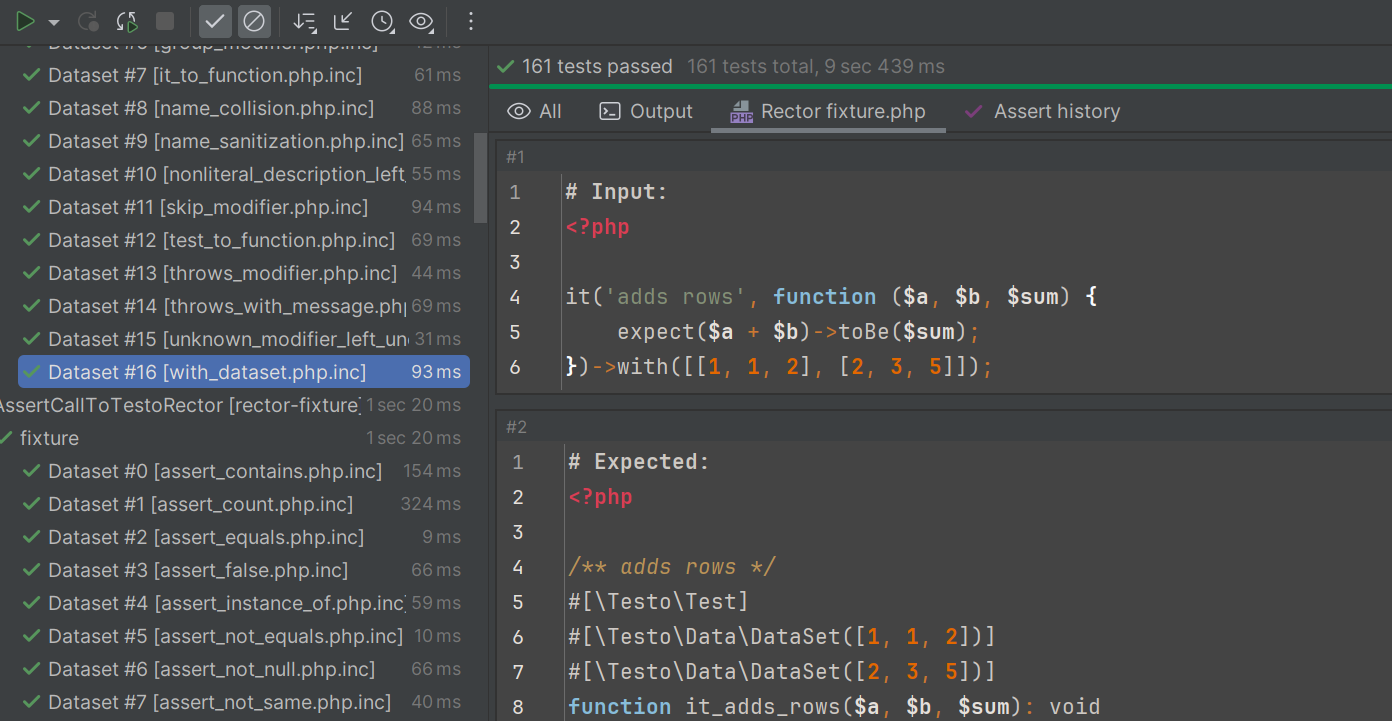
On top of that, each fixture's input and expected output are streamed to a messenger channel, so you see the "before → after" of every case right in the report:
Setup
The toolkit plugs in as an ordinary suite plugin. Create a suite that scans your rule sources and add RectorTestingPlugin\Testo\Bridge\Rector\Testing\RectorTestingPlugin to it:
// suites.php
use Testo\Application\Config\FinderConfig;
use Testo\Application\Config\SuiteConfig;
use Testo\Bridge\Rector\Testing\RectorTestingPlugin;

return [
    new SuiteConfig(
        name: 'Rector',
        location: new FinderConfig(include: [__DIR__ . '/src']),
        plugins: [new RectorTestingPlugin()],
    ),
];
The plugin discovers every rule carrying the #[TestRectorFixtures]#[TestRectorFixtures(string ...$paths)]Declares the fixtures that exercise a Rector rule. attribute and runs its fixtures.
#[TestRectorFixtures]
Declares the fixtures that exercise a Rector rule.
#[TestRectorFixtures(string ...$paths)]Placed on a rule class. Takes one or more paths to fixtures — directories or single files; a directory is scanned for *.php.inc fixtures.
The plugin fans the rule out into one data set per fixture, just as a #[DataProvider]#[DataProvider(callable|string $provider)]Provides data for a parameterized test from a method or callable. expands a parameterized test.
Parameters:
$paths- Paths to directories or files with fixtures — relative (to the rule's file) or absolute, within the project.
Examples:
#[TestRectorFixtures('Fixture/AssertCallToTestoRector')]
final class AssertCallToTestoRector extends AbstractRector { /* … */ }
Fixture format
A fixture is a *.php.inc file holding the input and the expected output, separated by a ----- line. If there is no separator, the rule is expected to leave the input unchanged — handy for the "must not touch this" cases:
<?php

class SomeTest
{
    public function test()
    {
        $this->markTestIncomplete('todo');
    }
}
-----
<?php

class SomeTest
{
    public function test()
    {
        throw new \Testo\Core\Exception\SkipTest('Incomplete: todo');
    }
}
Each fixture runs through a freshly-booted Rector container and is reported as its own data set, so a failing conversion points you straight at the offending file.
Reusable by design
The toolkit ships with the package so downstream rule authors can reuse it — testo/* are require-dev plus a suggest, and the fixtures themselves are export-ignored. If you write Rector rules and use Testo, this harness is available to you out of the box.